

As one of the more esoteric supplements, this may be the first time you’ve heard of Diindolyl-methane. Even if you have heard of it before, you may not know much about it. Whichever camp you fall into, this guide from the Supplement Needs team is for you…
What is DIM (Diindolyl-Methane)?
DIM, or 3,3’-diindolyl-methane, is a compound your body produces endogenously (internally) after eating cruciferous vegetables like broccoli, kale, and Brussels sprouts - but contrary to how it’s often marketed, it isn’t really ‘in’ those vegetables at all. It’s formed inside you, post-facto ingestion of those previously mentioned veggies.
So, how exactly is it produced?
Put simply, DIM is created when indole-3-carbinol (I3C), a breakdown product of glucosinolates in cruciferous vegetables, meets stomach acid. Under these conditions, I3C undergoes acid-catalysed condensation, and DIM forms as the major product of that reaction1.
Without going into too much technical detail, DIM is structurally a dimer of I3C - two indole-3-carbinol molecules joined together - which is reflected in its full chemical name that we saw earlier - 3,3’-diindolylmethane2.
The ‘DIM in food’ contention
You’ll see plenty of talk online about DIM-rich foods - but this is a slight mistake by those commentators.
Rather - it would be more correct to say ‘foods that fuel DIM production’. This is because I3C itself isn’t naturally present in raw cruciferous vegetables - it’s released from the glucosinolate glucobrassicin only once the plant is cut, chewed or cooked. DIM then forms afterwards, when I3C reaches the acidic environment of the stomach.
Where did DIM come from?
As we mentioned at the outset of this article, DIM is not as widely known as many of the other substances that you see popularly transformed into supplement form.
So, what are the roots of DIM supplementation?
DIM’s supplement popularity traces back to cancer chemoprevention research, particularly studies into oestrogen metabolism and hormone-driven cancers. Much of the clinical work on absorption-enhanced DIM (branded BioResponse-DIM) has come out of the Barbara Ann Karmanos Cancer Institute at Wayne State University, including early-phase dose-escalation trials in prostate cancer patients3.
How your body makes DIM from cruciferous vegetables
We’ve seen, then, that cruciferous vegetables are very much the ‘fuel’ required for your body to produce DIM endogenously.
Naturally, any curious reader’s next question is undoubtedly going to be, “but how?”
Good question! Which is what we’ll answer next.
The pathway, step-by-step
The process starts with glucobrassicin, an indole-containing compound found in cruciferous vegetables. Chopping, chewing, or cooking activates the enzyme myrosinase, which breaks glucobrassin down into an unstable intermediate that rapidly converts to indole-3-carbinol (I3C).
I3C is unstable in acid, so once it reaches the stomach, it undergoes acid-catalysed condensation into DIM4.
Which vegetables supply the most glucobrassicin?
So, if what we need to increase DIM levels in our bodies is more glucobrassicin - what vegetables can supply the latter?
The answer is your classic cruciferous greens:
-
Broccoli.
-
Brussels sprouts.
-
Cabbage.
-
Cauliflower.
-
Kale.
-
Bok choy.
-
Mustard greens.
A key point here though - is that they don’t offer uniform amounts of glucobrassicin. For example, a study of Brassica oleracea crops found that glucobrassicin levels differed several-fold between Brussels sprouts, cabbage, cauliflower, and kale - and varied further between individual cultivars of the same vegetable5.
The importance of cooking methods
As with other important compounds, vitamins and minerals (vitamin C in greens being a classic example), your choice of cooking method can have a major influence upon how much active glucobrassicin you actually end up eating.
Boiling is particularly destructive to glucobrassicin: one study measured losses of over 70% in boiled Brussel sprouts, alongside significant losses from blanching too6. Heat also deactivates myrosinase, the enzyme needed to release I3C in the first place. As an interesting aside, mustard seeds are high in myrosinase, which you can add to broccoli and other similar cruciferous vegetables to further help your intake.
Instead, look to eat cruciferous vegetables either raw or lightly steamed to maximise absorption of glucobrassicin.
Is it possible to get supplementation-level doses from food?
It’s all very well us talking about obtaining glucobrassicin from food - the key question is, “can you get meaningful amounts from food?” - or will you have to spend your life constantly eating raw Brussel sprouts to achieve a dose even near a supplement?
The answer is it’s genuinely hard to quantify.
In one of the few controlled human feeding studies, 25 people ate 50g of raw Brussels sprouts or cabbage daily for three days, and researchers successfully measured the resulting rise in urinary DIM7.
Before you rush out to buy a lifetime supply of Brussel sprouts, there are a few caveats to that study. Firstly, the study wasn’t actually designed to establish a food-to-supplement dose equivalence, and secondly, no rigorous published research has done so.
Nevertheless, such studies do give us some good food for thought (if you’ll excuse the pun).
How DIM works: Oestrogen metabolism explained
Whether your DIM comes from a supplement or a heaped plate of Brussels sprouts, the amount that actually reaches your system can vary depending on your physiology.
Nevertheless, arguably the most important question in this article is “what does DIM actually do when it is absorbed by your body?”
Despite what you may have heard, DIM’s best-supported action isn’t lowering oestrogen - it’s changing which chemical pathway your liver uses to break oestrogen down (an important, if somewhat nuanced distinction).
In this next section, we’ll look at this important nuance in more detail.
Oestrogen metabolism
Oestrogen isn’t simply produced and then ‘used up’ - it’s continuously broken down and cleared through a two-phase liver process. In phase 1, enzymes called cytochrome P450s hydroxylate oestrogen into different metabolites. In phase 2, those metabolites are chemically modified - methylated, glucuronidated, or sulphated - to make them water-soluble enough to be excreted in urine and bile8.
The three hydroxylation routes
Phase 1 isn’t a single, fixed pathway, though - it can send oestrogen down three different routes, and this is exactly where DIM’s effect comes into play. Hydroxylation produces 2-hydroxyestrone (2-OHE1), 4-hydroxyestrone (4-OHE1), or 16a-hydroxyestrone (16a-OHE1), catalysed predominantly by CYP1A1, CYP1A2, and CYP1B19.
These aren’t interchangeable: 2-OHE1 binds the oestrogen receptor weakly and is considered comparatively benign, 16a-OHE1 binds more strongly and has been linked to proliferative, oestrogenic effects, and 4-OHE1 can form reactive quinones capable of damaging DNA10.
DIM’s primary action
So, now we get to the crux of the issue.
Which of these routes does DIM push you toward? DIM is a weak agonist of the aryl hydrocarbon receptor (AhR), and through this, it induces CYP1A1 activity - favouring 2-hydroxylation over the other two routes11.
This is the mechanism behind almost every ‘DIM balances oestrogen’ claim that you’ll see.
DIM and the androgen receptor
Everything so far describes DIM’s role in oestrogen metabolism - which is how it’s almost always marketed. But, there’s a second mechanism that gets far less attention, particularly in products aimed at men: DIM’s direct action on the androgen receptor.
In a widely cited 2003 study12, DIM competitively blocked dihydrotesterone (DHT) from binding the androgen receptor in prostate cancer cells, prevented androgen-receptor translocation into the cell nucleus, and reduced PSA expression13. That’s a meaningfully different story to the one told on most bodybuilding forums.
DIM vs Indole-3-Carbinol (I3C): what’s the difference?
We’ve already mentioned I3C repeatedly - as it’s the raw material DIM is produced from - but I3C is also sold as a supplement in its own right. So, it’s worth being clear about why the two aren’t interchangeable, and why DIM specifically has become the more commonly supplemented form.
Let’s take a closer look.
Precursor vs product
I3C is the raw material, DIM is what your stomach acid turns much of it into. Take an I3C supplement and your body still has to do that conversion before it reaches circulation in any meaningful, stable form.
To put it another way - you may as well take the final form rather than the precursor!
Why I3C conversion isn’t variable
That conversion isn’t clean or predictable. Under acidic conditions, I3C doesn’t just form DIM - it breaks down into a mixture of at least five identified compounds, including DIM, indolo[3,2-b] carbazole (ICZ) and a linear trimer known as LTr1, with the exact mix depending on pH and individual gut conditions.
Common DIM myths
Like many supplemented substances, DIM is subject to a number of ‘urban myths’ and overclaims. We’ve outlined the most common of these below.
“DIM lowers oestrogen”
This is the most common misconception, and it’s not quite right. As covered earlier, DIM’s best-supported action is redirecting oestrogen down the 2-hydroxylation pathway rather than reducing overall oestrogen production or circulating levels14.
Note: DUTCH (Dry Urine Testing for Comprehensive Hormones) can help show these pathways and which ones are dominant. If you are interested in this test, we are able to offer it. Please contact us for more details.
“DIM burns belly fat”
This claim traces back to a single small trial, and it’s worth reading past the headline. A randomised, double-blind trial gave 60 premenopausal women either 75mg/day of absorption-enhanced DIM or placebo for 30 days. The trial’s own primary endpoint - a shift in the urinary oestrogen metabolite ratio - did not reach significance (p > 0.05), and the reported changes in body composition were non-significant trends, not a proven fat-loss effect15.
“DIM is a natural aromatase inhibitor”
This one doesn’t hold up well under scrutiny. The most-cited study examining DIM’s effect on aromatase (CYP19) - the enzyme that converts androgens into oestrogens - actually found that DIM induced CYP19 activity in human adrenal cells, alongside CYP1A1 and CYP1B1, rather than inhibiting it16. ‘Induced’ here means the opposite of what the marketing claim suggests - it means DIM sped the enzyme up, increasing aromatase activity rather than blocking it. A separate study in breast cell lines found the effect on aromatase expression was cell-type dependent - decreased in oestrogen-dependent cells, but increased in oestrogen-independent cells17. That’s not the profile of a reliable aromatase inhibitor.
DIM dosage and absorption
As we often say here at Supplement Needs, a supplement is only as good as its bioavailability, which is what we’ll look at next concerning DIM.
Why crystalline DIM is poorly absorbed
DIM is a fat-soluble compound with very low water solubility, which limits how much of a standard, unformulated (“crystalline”) oral dose actually crosses into the bloodstream rather than passing through the gut largely unabsorbed. This is the starting problem every DIM formulation has to solve.
Absorption-enhanced DIM
To address it, formulators have developed microencapsulated and lipid-carrier versions of DIM (commonly marketed as BioResponse-DIM or similar). In a pharmacokinetic modelling study in mice, this absorption-enhanced formulation achieved roughly 50% higher bioavailability than an equivalent dose of crystalline DIM18.
Why a milligram figure is meaningless without the form
Because of that absorption gap, “200mg DIM” on two different labels can deliver meaningfully different amounts of DIM into actual circulation, depending on whether it’s crystalline or absorption-enhanced. The number on its own tells you very little; the formulation behind it tells you much more.
It’s for this reason (amongst others) that you’ll find the exact form of all ingredients listed clearly on Supplement Needs products.
What to look for in a DIM supplement
Understanding the science above is one thing: but translating it into an actual buying decision is another. This section is designed to help you choose a DIM supplement that will help you achieve your health goals (and ensure you don’t buy a dud!).
Here are the key things to look for when buying a DIM supplement.
State DIM content
A supplement should state the actual milligram amount of DIM itself, not hide behind a proprietary ‘cruciferous vegetable blend’ or ‘indole complex’ that doesn’t specify how much DIM is actually present in the supplement.
If you can’t find a DIM-specific number on the label, leave that supplement on the shelf!
A genuine absorption-enhancement system
As we mentioned earlier, crystalline DIM is poorly absorbed, whilst microencapsulated or lipid-carrier formulations achieve meaningfully higher bioavailability. A well-formulated product should specify which absorption technology it uses - not just claim to be ‘enhanced’ without saying how.
Transparent, non-proprietary labelling
The dose should sit within clinically tested ranges - and every active ingredient should be individually declared, rather than buried inside an undisclosed proprietary blend where you can’t see how much of anything you’re actually getting.
Manufacturing standards
Look for manufacturing in a facility operated to Good Manufacturing Practice (GMP) standards - the baseline expectation for consistency, hygiene, and quality control in supplement production, and a marker of a formulator taking manufacturing seriously rather than outsourcing to the lowest-cost producer.
As you’d expect, Supplement Needs ticks ALL of these boxes!
Now, if you’re looking for a premium supplement that contains DIM, you’re going to want to buy…
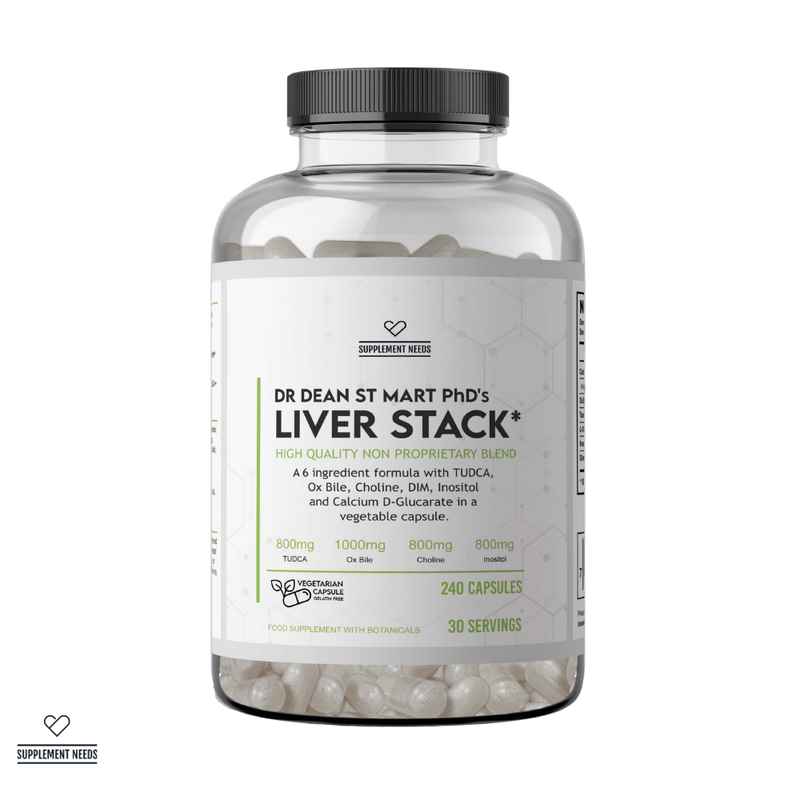
Supplement Needs Liver Stack

Every criterion above is a way of separating a well-made DIM product from a poorly made one - but it’s easier to judge against a real example than a checklist alone. Currently, our one DIM-containing supplement is Liver Stack.
Here’s how it measures up:
-
200mg DIM per full daily serving: sitting comfortably within the 100-300mg/day range used in human research.
-
Paired with 1,000mg Calcium D-Glucarate: one of DIM’s most logical stacking partners, included at a clinically relevant amount.
-
Fully transparent, non-proprietary label: every ingredient and its exact dose disclosed, with zero hidden blends.
-
Formulated by Dr Dean St. Mart PhD: an industry leading formulator.
-
Manufactured in the UK: to GMP and ISO-accredited standards, with a fully-traceable certificate of analysis.
If you’re ready to add DIM to your daily supplementation regime, then you won’t do better than Supplement Needs.
Shop Liver Stack at Supplement Needs now
For more insights and information about supplements, read the Supplement Needs blog…
The Fertility Supplement You Probably Haven’t Heard of: A Guide to NAC | How to Improve Prostate Health Naturally | Supplements That Can Help With Fatty Liver
Disclaimer
The information contained on this website should not be used as a substitute for medical care or advice. If you have questions about your health, please contact your doctor.
References:
1. Linus Pauling Insitute. Indole-3-Carbinol [online]. Available at: https://lpi.oregonstate.edu/mic/dietary-factors/phytochemicals/indole-3-carbinol (Accessed on 16th August 2026).
2. National Library of Medicine. NTP Technical Report on the Toxicology Studies of Indole-3-carbinol in F344/N Rats and B6C3F1/N Mice and Toxicology and Carcinogenesis Studies in Indole-3-carbinol in Harlan Sprague Dawley Rats and B6C3F1/N Mice Gavage Studies [online]. Available at: https://www.ncbi.nlm.nih.gov/books/NBK561029/ (Accessed on 16th August 2026).
3. Heath E, Heilbrun L, Li j, et. al. A phase I dose-escalation study of oral BR-DIM (BioResponse 3,3’-Diindolylmethane) in castrate-resistant, non-metastatic prostate cancer [online]. Available at: https://pubmed.ncbi.nlm.nih.gov/20733950/ (Accessed on 16th August 2026).
4. Srikanth Y, Reddy D, Anusha V, et. al. Unveiling the Multifaceted Pharmacological Actions of Indole-3-Carbinol and Diindolylmethane: A Comprehensive Review [online]. Available at: https://pmc.ncbi.nlm.nih.gov/articles/PMC11902694/ (Accessed on 16th August 2026).
5. Kushad M, Brown A, Kurilich A, et. al. Variation of Glucosinolates in Vegetable Crops of Brassica oleracea [online]. Available at: https://pubs.acs.org/jafcau/article-abstract/47/4/1541/1334915/Variation-of-Glucosinolates-in-Vegetable-Crops-of?redirectedFrom=fulltext (Accessed on 16th August 2026).
6. Lafarga T, Bobo G, Vinas I, et. al. Effects of thermal and non-thermal processing of cruciferous vegetables on glucosinolates and its derived forms [online]. Available at: https://pmc.ncbi.nlm.nih.gov/articles/PMC5976619/ (Accessed on 16th August 2026).
7. Fujioka N, Ainslie-Waldman C, Upadhyaya P, et. al. Urinary 3,3’-diindolylmethane: a biomarker of glucobrassicin exposure and indole-3-carbinol uptake in humans [online]. Available at: https://pubmed.ncbi.nlm.nih.gov/24357105/ (Accessed on 16th August 2026).
8. Obi N, Vrieling A, Heinz J, et. al. Estrogen metabolite ratio: Is the 2-hydroxyestrone to 16a-hydroxestrone ratio predictive for breast cancer? [online]. Available at: https://www.tandfonline.com/doi/full/10.2147/IJWH.S7595 (Accessed on 31st August 2026).
9. Cribb A, Knight M, Dryer D, et. al. Role of Polymorphic Human Cytochrome P450 Enzymes in Estrone Oxidation [online]. Available at: https://aacrjournals.org/cebp/article/15/3/551/171927/Role-of-Polymorphic-Human-Cytochrome-P450-Enzymes (Accessed on 31st August 2026).
10. Obi N, Vrieling A, Heinz J, et. al. Estrogen metabolite ratio: Is the 2-hydroxyestrone to 16a-hydroxyestrone ratio predictive for breast cancer? [online]. Available at: https://www.tandfonline.com/doi/full/10.2147/IJWH.S7595 (Accessed on 31st August 2026).
11. Sanderson J, Slobbe L, Lansbergen G, et. al. 2,3,7, 8-Tetrachlorodibenzo-p-dioxin and diindolylmethanes differently induce cytochrome P450 1A1, 1B1, and 19 in H295R human adrenocortical carcinoma cells [online]. Available at: https://pubmed.ncbi.nlm.nih.gov/11294972/ (Accessed on 31st August 2026).
12. Le H, Schaldach C, Firestone G, et. al. Plant-derived 3,3’-Diindolylmethane Is a Strong Androgen Antagonist in Human Prostate Cancer Cells [online]. Available at: https://www.jbc.org/article/S0021-9258(20)73423-X/fulltext (Accessed on 6th September 2026).
13. Anderton M, Manson M, Verschoyle R, et. al. Pharmacokinetics and Tissue Disposition of Indole-3-carbinol and Its Acid Condensation Products after Oral Administration to Mice [online]. Available at: https://aacrjournals.org/clincancerres/article/10/15/5233/182212/Pharmacokinetics-and-Tissue-Disposition-of-Indole (Accessed on 6th September 2026).
14. Sanderson J, Slobbe L, Lansbergen G, et. al. 2, 3, 7, 8-Tetrachlorodibenzo-p-dioxin and diindolylmethanes differentially induce cytochrome P450 1A1, 1B1, and 19 in H295R human adrenocortical carcinoma cells [online]. Available at: https://pubmed.ncbi.nlm.nih.gov/11294972/ (Accessed on 6th September 2026).
15. Godinez-Martinez E, Santillan R, Samano R, et. al. Effectiveness of 3,3’-Diindolylmethane Supplements on Favoring the Benign Estrogen Metabolism Pathway and Decreasing Body Fat in Premenopausal Women [online]. Available at: https://www.tandfonline.com/doi/abs/10.1080/01635581.2022.2123535 (Accessed on 6th September 2026).
16. ibid.
17. Licznerska B, Szaefer H, Murias M, et. al. Modulation of CYP19 expression by cabbage juices and their active components: indole-3-carbinol and 3,3’-diindolylmethane in human breast epithelial cell lines [online]. Available at: https://pmc.ncbi.nlm.nih.gov/articles/PMC3715682/ (Accessed on 6th September 2026).
18. Anderton M, Manson M, Verschoyle R, et. al. Physiological Modeling of Formulated and Crystalline 3,3’-Diindolylmethane Pharmacokinetics Following Oral Administration in Mice [online]. Available at: https://dmd.aspetjournals.org/article/S0090-9556(24)02925-8/abstract (Accessed on 6th September 2026).